System integration
SAP and non-SAP applications on one integration layer
Integration estates usually grow one interface at a time, each in the technology available when it was needed. Consolidating them onto one layer gives a single path into the landscape and one definition of master data across it.
EADX builds these landscapes on SAP Integration Suite. Paths we build run on Cloud Integration; where SAP provides a managed service for a path, that service is used under the same templates and monitoring. SAP and non-SAP endpoints are governed identically.
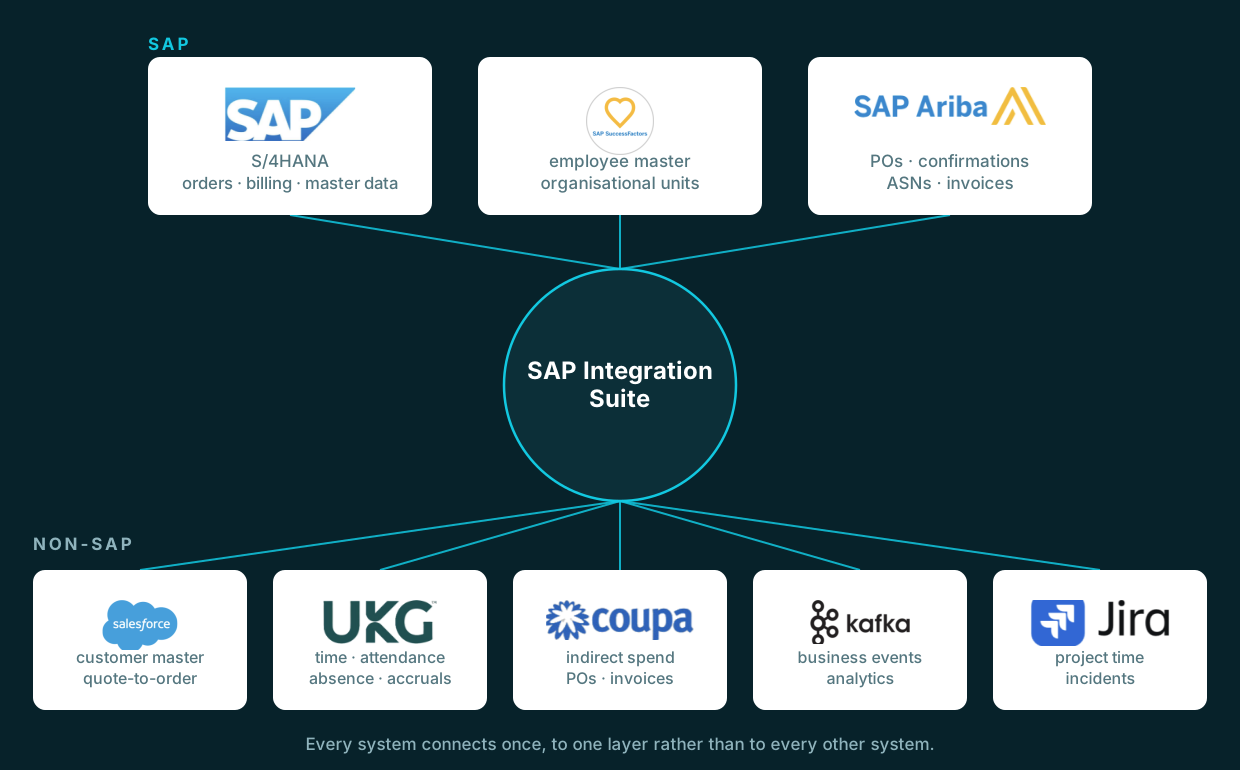
Scroll the diagram sideways on a narrow screen.
The integrations in scope
Where SAP ships standard content we use it, marked below. Everything else was built by EADX.
SAP SuccessFactors to UKG, including payroll
Employee demographics, job data, organisational assignment and scheduling groups move from Employee Central to UKG. Time, attendance, absence and accruals come back for the payroll run, reconciled before that run. No standard SAP content covers this path, so it was built, including the shift and absence catalogue and effective-dated handling of mid-period changes.
SAP SuccessFactors and SAP S/4HANA
Employee master and organisational units move from Employee Central into SAP S/4HANA. Cost centres move the other way, through SAP Master Data Integration. Standard content, extended for the customer's organisational model.
SAP standard contentSalesforce and SAP S/4HANA
Customer master synchronises both ways. Price list and credit status move from SAP S/4HANA to Salesforce. An accepted quote creates the sales order without re-keying, and order, delivery and invoice status return as events over Event Mesh.
SAP Ariba and SAP S/4HANA
Requisitions and approvals run in SAP Ariba. Purchase orders, order confirmations, advance ship notices and supplier invoices are exchanged with suppliers over SAP Business Network, through SAP Integration Suite, managed gateway for spend management and SAP Business Network.
SAP standard contentCoupa and SAP S/4HANA
Indirect and tail spend: requisitions, purchase orders, receipts and invoices, with supplier master, cost centres and approval hierarchy moving from SAP S/4HANA into Coupa. Coupa and SAP Ariba write into the same canonical purchase-order and supplier-invoice objects.
SAP S/4HANA to Apache Kafka
Order, delivery and billing events are published once as version-contracted messages. The data platform consumes events rather than reading the ERP database, so analytics follows the event contract rather than the ERP release calendar.
Jira and SAP S/4HANA
Project time bookings move to SAP S/4HANA for project costing. Any message that needs attention opens an enriched Jira issue automatically, carrying the message ID, the step it stopped at and the reprocessing procedure.
SAP and non-SAP under the same standards
Salesforce, UKG, Coupa, Kafka and Jira run under the same templates, governance and monitoring concept as the SAP systems, so one team and one set of standards covers the landscape. A second integration tool is introduced only where a capability requires one.
Design and operating standards
One template set
Error handling, retry, logging and alerting behave identically in every flow. Deviations require architecture sign-off and are documented, so the same procedure applies to every flow.
A canonical data model
One internal representation each for employee, business partner, purchase order, sales order and supplier invoice. A new system maps once, rather than to every other system separately.
Secured and governed
OAuth 2.0 or mTLS on every connection we build, centrally managed certificates with monitored expiry, and API Management policies for rate limiting, payload validation and threat protection.
Versioned and transported
Integration content is versioned in Git and transported through development, quality and production with SAP Cloud Transport Management and the Content Agent service.
SAP PI/PO mainstream maintenance ends 31 December 2027
Extended maintenance runs to 31 December 2030 at a premium. In our experience a prepared migration runs smoothly and the teams it touches adapt well, so it is worth starting early rather than in the final months.
Talk to one of our consultants, or use the button for the detail.
Read next
All references
ERP consolidation
Four ERP systems migrated to one SAP S/4HANA core
Master and transactional data migrated from four source systems into a single SAP S/4HANA target, with SAP Transportation Management in the new landscape. Delivered on time and on budget.
Read the case
SAP PO to SAP Integration Suite migration
363 interfaces from SAP Process Orchestration
Every interface migrated to SAP Integration Suite and validated individually against production data, with no reported interruption to plant operations.
Read the case