SAP PO to SAP Integration Suite migration
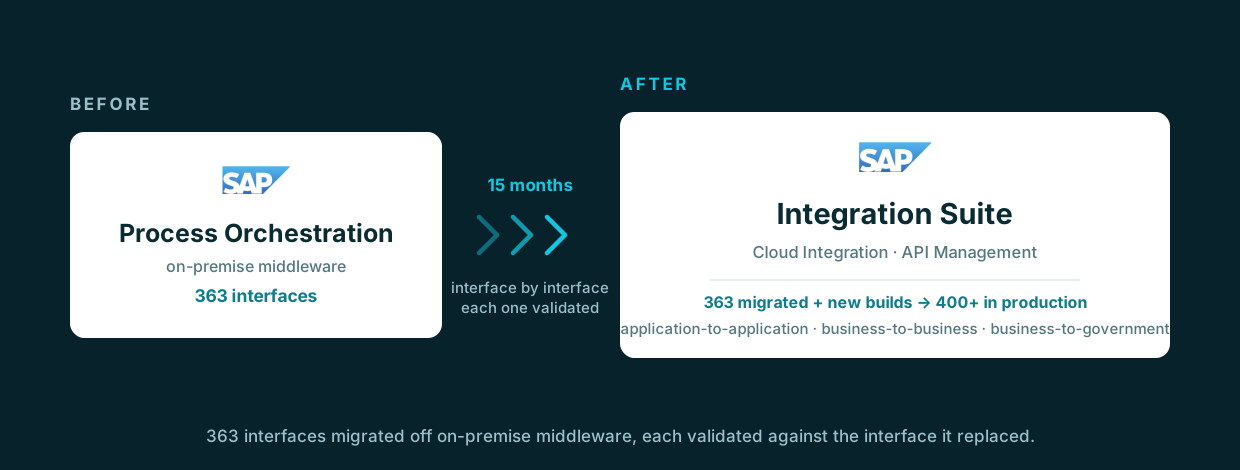
363 interfaces migrated from SAP Process Orchestration to SAP Integration Suite
Each interface migrated and validated individually, with no reported interruption to plant operations.
Chemicals manufacturer
The customer set out to run more efficient operations by integrating and automating processes across the company. That meant moving its on-premise enterprise solutions to cloud infrastructure, with SAP S/4HANA Cloud Private Edition (today SAP Cloud ERP Private) at the core and cloud solutions for analytics and data warehousing alongside it.
Integration connected the systems inside the landscape and the paths out to partners, customers and authorities. Continuity of plant operations was a condition of the design from the start.
Scroll the diagram sideways on a narrow screen.
Migration approach
Methodology before product selection
Integration requirements were classified with the SAP Integration Solution Advisory Methodology, which gave the strategy a documented shape before any product decision. The shortlist was then evaluated against it. SAP Integration Suite was selected on capability coverage for the integration domains in scope, A2A and B2B/B2G, on developer experience and on total cost, and adopted as the enterprise integration solution for all SAP and third-party systems.
363 interfaces migrated
Moved off SAP Process Orchestration, the existing on-premise middleware. Prepackaged content from SAP Business Accelerator Hub was used where it fitted and existing mappings reused where appropriate. New interfaces were built alongside the migration, taking the total in production past 400.
API Management for connectivity outside the company
External APIs are secured, governed and managed through the API Management capability of SAP Integration Suite, with more than 650,000 calls a month. Partners and customers connect through one standardised, secured path rather than through connections agreed one at a time.
Validated before it went live
Every interface was validated and signed off before it went live, so nothing was proven for the first time in production. By the time the business was asked to work on the new platform, each connection had already been shown to behave as the one it replaced.
Automated interface testing
Migrated interfaces were regression-tested against recorded production messages, pseudonymised for the test tenant, using a third-party instrument for migration and regression testing. Each flow was compared payload by payload against the interface it replaced. Automating that comparison made it practical to validate all 363 interfaces rather than a sample, so every one of them was evidenced against production behaviour before it went live.
Operations after go-live
Alerting emails the responsible person as soon as a connection needs attention, and a self-service dashboard lets the business follow and resolve items alongside IT, so the status of every interface is visible to both.
A2A, B2B and B2G on one platform
Application-to-application, business-to-business and business-to-government scenarios all run on the same integration layer, under the same governance and the same monitoring.
An IoT-triggered reorder process
One of the end-to-end processes checks how much product is left in a customer's tank and triggers the reorder automatically. The customer sees their own consumption, and the company sees demand before it arrives. The integration supports a customer-facing service as well as internal processes.
Operating results
Faster to build
Ready-to-go content and the developer experience of the suite made new integration requirements 50% faster to implement, reducing development effort on the requests that followed.
No reported interruption
Plants and processes moved to the cloud with no reported business interruption.
Simpler to operate
Interface management was simplified after go-live. Alerts reach the responsible person directly, and the self-service dashboard puts first-level diagnosis in the hands of the business instead of a ticket queue.
Effect on future integrations
API-based integration makes it faster to connect with third-party systems, tying the company's processes to those of its partners and customers.
SAP PI/PO mainstream maintenance ends 31 December 2027
Extended maintenance runs to 31 December 2030 at a premium. In our experience a prepared migration runs smoothly and the teams it touches adapt well, so it is worth starting early rather than in the final months.
Talk to one of our consultants, or use the button for the detail.
Read next
All references
System integration
SAP and non-SAP on one integration layer
One governed integration layer across SAP SuccessFactors, SAP S/4HANA, SAP Ariba, Salesforce, Coupa, UKG, Apache Kafka and Jira, under a single set of templates and one canonical data model.
Read the case
ERP consolidation
Four ERP systems migrated to one SAP S/4HANA core
Master and transactional data migrated from four source systems into a single SAP S/4HANA target, with SAP Transportation Management in the new landscape. Delivered on time and on budget.
Read the case