ERP consolidation
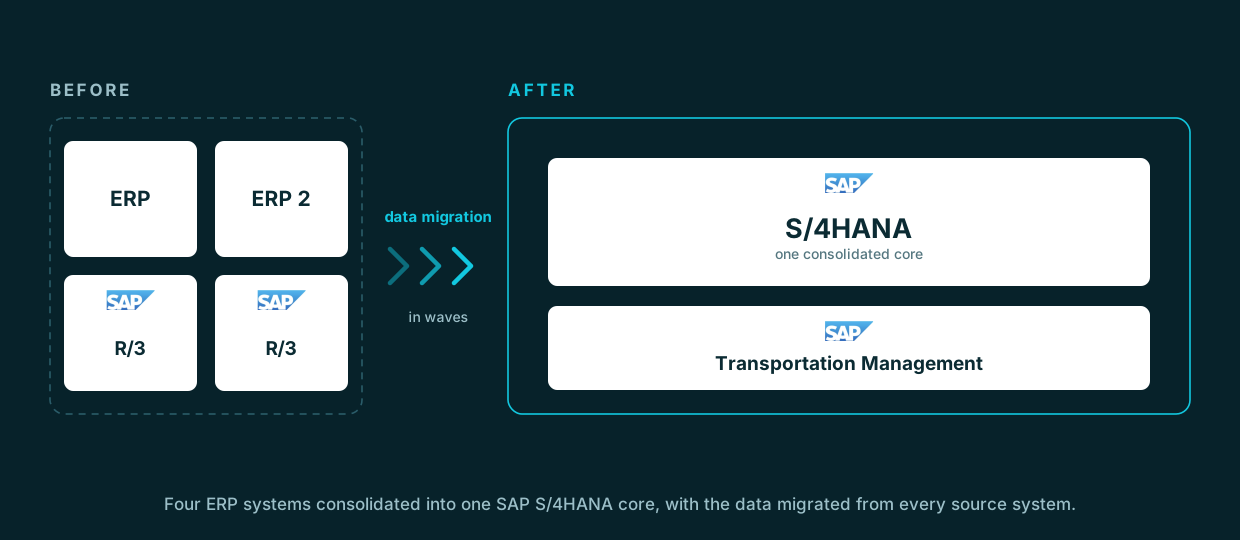
Four ERP systems consolidated and migrated to one SAP S/4HANA core
Master and transactional data migrated from four source systems into a single target, with SAP Transportation Management in the new landscape.
Large media and communications company
The customer ran four SAP ERP systems side by side: two ERP instances and two R/3 systems. Each carried its own master data, its own release level and its own web of point-to-point interfaces, and group reporting was assembled from all four.
The programme consolidated all four into one SAP S/4HANA core, with SAP Transportation Management in the target landscape. Master and transactional data was migrated from every source system, and the surrounding integration was rebuilt rather than carried forward. The programme was delivered on time and on budget.
Scroll the diagram sideways on a narrow screen.
Scope of the consolidation
Data migration from four sources into one
Master and transactional data was consolidated from four source systems into a single SAP S/4HANA target. Overlapping master data, including customers, vendors, materials and chart of accounts, was mapped, cleansed and deduplicated rather than loaded four times, with reconciliation after every load cycle.
One target design for four landscapes
Four organisational models, four sets of configuration and four release levels were resolved into one target design before migration began. Where the source systems disagreed, the target definition was decided with the business rather than inherited from whichever system happened to be largest.
SAP Transportation Management in the target design
Transportation management was integrated with the consolidated core as part of the target architecture, rather than added after go-live once the surrounding integration decisions had already been made.
On time and on budget
A four-system consolidation affects every business process in the company. This programme was completed on the committed date and within the committed budget.
Integration rebuilt around the new core
The integration layer was rebuilt against the consolidated model as part of the same programme, so the new core started with interfaces designed for it and a single set of dependencies to maintain.
Business validation at every step
Each load cycle was reconciled and signed off by the business before the next one began, so the target core was proven with real data well before anyone was asked to work in it.
Migration approach
One core, one master data model
Four sets of customers, vendors and materials were reconciled into a single model before they were loaded. Reconciling before loading is what allowed the business to work in the target core from the first day.
Migration in waves
Each wave was loaded, reconciled and signed off by the business before the next one began, so the target core was proven with real data well before the business started working in it.
Integration decided up front
The target integration layer was designed alongside the target core, so interfaces were built once against the consolidated model instead of being migrated first and rebuilt afterwards.
A method that repeats
Source inventory and classification, a single target data model, a wave plan ordered by business risk, and reconciliation after every load. The same sequence is what we bring to the next SAP S/4HANA consolidation.
SAP PI/PO mainstream maintenance ends 31 December 2027
Extended maintenance runs to 31 December 2030 at a premium. In our experience a prepared migration runs smoothly and the teams it touches adapt well, so it is worth starting early rather than in the final months.
Talk to one of our consultants, or use the button for the detail.
Read next
All references
System integration
SAP and non-SAP on one integration layer
One governed integration layer across SAP SuccessFactors, SAP S/4HANA, SAP Ariba, Salesforce, Coupa, UKG, Apache Kafka and Jira, under a single set of templates and one canonical data model.
Read the case
SAP PO to SAP Integration Suite migration
363 interfaces from SAP Process Orchestration
Every interface migrated to SAP Integration Suite and validated individually against production data, with no reported interruption to plant operations.
Read the case